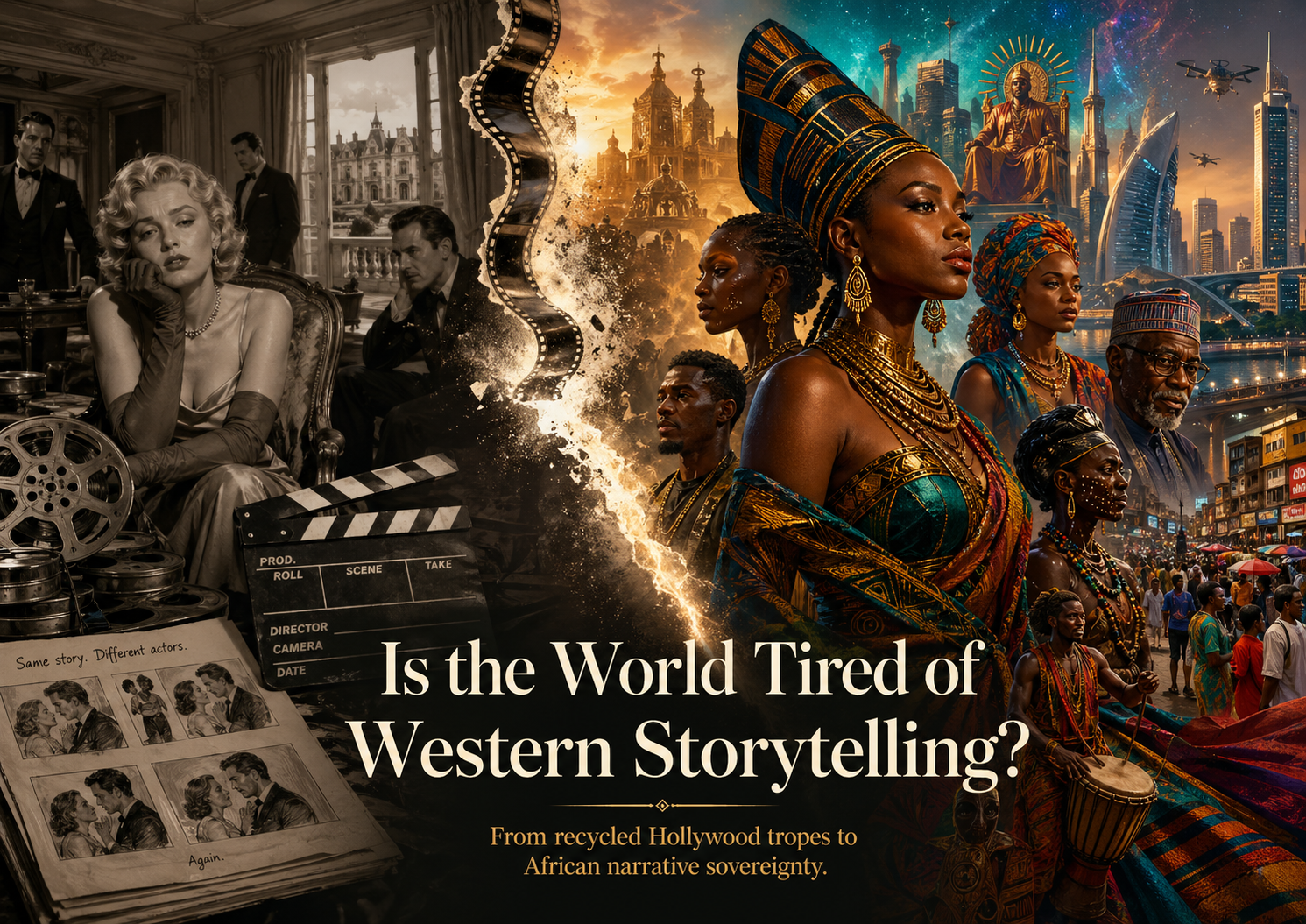

Is it just me, or has Western storytelling become painfully boring?
The same settings, emotional beats, character arcs, and sterile apartments. The same elite families, broken marriages, serial killers, billionaire dysfunction, and recycled trauma dressed up as prestige.
At a certain point, it is not depth. It is exhaustion.
Western storytelling has become predictable because the West has spent centuries centering itself as the default human experience. Every private neurosis, midlife crisis, and abstract anxiety gets funded, packaged, reviewed, defended, and distributed globally as if the world is still waiting for another version of the same story.
But are we?
Because I am bored.
And I do not think I am the only one.
What makes it worse is that when Western storytelling runs out of emotional, cultural, and visual material, it does what empire has always done: it extracts from other people’s cultures, then inserts whiteness back into the center.
Look at Beef.
The first season worked because it centered an Asian American world with specificity. It was not just “diverse casting.” It had texture. Culture. Family tension. Immigrant pressure. Class anxiety. Religious undertones. Humor. Shame. Rage. It gave us a world that felt culturally alive.
Then look at where the machine goes next. It still wants access to Korean culture, Korean imagery, Korean emotional complexity, and the global K-culture wave, but the center shifts. The culture becomes atmosphere. The people become context. The story wants the flavor without surrendering the frame.
That is the move.
Take the culture. Keep the aesthetic. Borrow the heat. Then make sure whiteness, or something close enough to it, remains central enough for Western comfort.
You see the same thing in Running Point.
Basketball culture is Black culture. The music, the swagger, the language, the emotional world, the commercial engine, the entire aesthetic ecosystem of professional basketball has been shaped overwhelmingly by Black people. The sport’s global cool factor comes from Black culture.
But the story centers a white family that owns the team.
Then, even on the player side, it still finds a way to foreground whiteness.
They cast a blonde woman as the president of a basketball team, then placed Thai and Hispanic characters around her to manufacture the appearance of inclusion. But that inclusion functions as cover. Black people are still displaced from the center of a story built on Black culture. It is the same maneuver America uses in law, workplace policy, education, and public life: Black suffering creates the moral crisis, but once reform arrives, the benefits are broadened, softened, and redistributed until white women and immigrant groups become the safer beneficiaries, while Black people are left fighting for access to the very remedies created in our name.
They will give us the same recycled lie: Black stories do not sell, Black casts are too risky, and global audiences need a white character at the center before they can care. But then how do you explain Insecure?
That show was Black in every ounce of it — the friendships, humor, music, language, neighborhoods, dating politics, awkwardness, codes, and culture. And white people watched it. They did not need whiteness centered to understand the story. They needed good writing, strong characters, emotional truth, and a world specific enough to feel alive. That is what the industry keeps pretending not to know: people will enter worlds that are not their own when the storytelling is strong enough to pull them in. The issue is not that Black stories cannot sell. The issue is that white centrality has been protected for so long that the industry mistakes its own habit for commercial reality.
This is not accidental. This is how Western storytelling protects power. It can consume Black culture, profit from Black rhythm, use Black music, borrow Black masculinity, sell Black cool, and still refuse to let Black people be the center of the story.
It wants the culture without the sovereignty, sound without the source, body without the authority. And somehow we are supposed to pretend this is just entertainment.
No. It is narrative control.
And narrative control has real-world consequences.
When whiteness is centered in every story, white people are centered in the real world. They remain the protagonists, the owners, the decision-makers, the emotional anchors, the universal point of reference. Everyone else becomes culture, flavor, setting, tension, conflict, soundtrack, or supporting cast.
That is not equality.
That is hierarchy disguised as entertainment.
This is why Western storytelling feels tired. The plots are predictable because the power structure behind the plots is predictable.
Whiteness must survive the story.
Even when the world is Korean, whiteness finds a way in. Even when the world is basketball, whiteness finds a way in. Even when the cultural engine is Black, Asian, African, Indigenous, immigrant, or non-Western, the Western machine still asks: how do we make this legible by putting ourselves back at the center?
That is not creativity.
That is insecurity with a production budget.
And when they are not extracting from other cultures, they fund their own abstraction to the point of absurdity. A film can be strange, dull, indulgent, emotionally empty, and still be treated as important because it comes from the “right” ecosystem. The most obscure Western anxiety becomes cinema. The most repetitive Western nightmare becomes prestige. The most self-involved artistic experiment gets distribution, marketing, interviews, and awards conversation.
Meanwhile, entire civilizations remain underfunded.
African stories are still treated as niche, risky, local, small, or “emerging,” even though Africa contains some of the richest human drama on earth.
Family systems. Kingdoms. Betrayals. Migrations. Spiritual worlds. Colonial ruptures. Postcolonial ambition. Class mobility. Corruption. Genius. Beauty. War. Love. Inheritance. Land. Power. Language. Memory. Music. Ritual. Futurism. Market women. Billionaires. Chiefs. Pastors. Rebels. Queens. Traders. Diaspora children. Returnees. Oil states. Mining corridors. Ancient empires. Modern cities. Village politics. Lagos ambition. Accra cool. Nairobi speed. Johannesburg tension. Abuja power.
The material is endless.
But African storytelling has not been funded at the level of its depth.
That is the real tragedy.
I cannot underscore this enough: Africans need to fund African stories.
Not as charity. Not as representation. Not as trauma content for Western consumption. Not as poverty cinema. Not as exotic backdrops for white characters to find themselves.
African stories need African capital, African ownership, African creative control, African distribution strategy, and African belief.
But we also have to be honest about the current structure of power. Global entertainment is still trapped inside America’s technofeudal grip. The platforms, algorithms, streaming systems, app stores, social media networks, search engines, payment rails, and algorithms are largely controlled by American technology companies. Even if African cinema is funded independently, it still often has to be amplified through Western-owned distribution infrastructure.
So Africa faces a choice.
Either we push for serious policies that stop Western tech platforms from suppressing African content through algorithms, removals, demonetization, recommendation bias, and visibility control — or we take the China approach: restrict their dominance across Africa, the Caribbean and the black world, then build our own platforms with the seriousness of civilizations that understand media as power.
Because African storytelling cannot be sovereign if African visibility is still controlled by foreign algorithms.
We can fund the films. We can own the IP. We can build the studios. We can train the creators. But if American tech companies still control the feeds, search results, app stores, monetization systems, and recommendation engines, then they still control which African stories reach the world and which ones disappear into digital silence.
They do not have to ban us outright.
They only have to make us harder to find.
That is why this is not just about film. It is about narrative infrastructure. China understood that American tech dominance was not neutral. It built walls, platforms, industries, and alternatives. Africa, the Caribbean and the black world must eventually decide whether we are going to keep begging foreign algorithms to carry our stories, or whether we are going to build the systems that make our stories impossible to suppress.
After all, by 2050 1 in 4 people alive will be African. And 1 in 3 young people will be African. It is imperative that we control our information ecosystem. If we do not have ownership we will remain dependent on the same structures that have historically ignored, diluted, extracted from, or misrepresented us.
When African stories are told with scale, discipline, beauty, intelligence, and production quality, the world will not be bored. The world will realize it has been watching the same empire talk to itself for too long.
And this is why AI matters.
AI is beginning to democratize visual imagination. It gives African storytellers a way to create without waiting for Netflix, Amazon, Hollywood, foreign grants, festival approval, or some development executive to decide that our worlds are finally worthy of being seen.
For decades, the excuse was cost. African stories were considered too expensive, too local, too difficult to sell, too risky to produce at scale. But cost was only one layer. The money has always been on the ground in Africa. The deeper problem was the knowledge gap.
America did not just dominate cinema because it had capital. It dominated because it gatekept the intellectual property of production: the studio systems, financing models, legal structures, distribution networks, marketing machinery, and institutional discipline that turn film from creative expression into a profitable industry.
That is the part people miss. Film is not just art. Film is an operating system. Without institutions that protect investors, manage budgets, enforce accountability, distribute content, and turn stories into repeatable commercial assets, African cinema remains dependent on individual filmmakers instead of industry machinery.
And when many of the people with capital are from older generations raised on Western content, they may have money, but not always the imagination or commercial confidence to see African worlds as global assets.
So the issue was never African imagination. It was the gatekeeping of production knowledge, the weakness of institutional infrastructure, and the absence of systems that make storytelling investable at scale.
Holywood’s dominance emerged from the American empire itself. America became a superpower at the same time the camera, cinema, mass media, television, and later digital platforms became the dominant tools of global imagination. For more than a century, America had the technological, financial, and industrial edge in visual storytelling. Hollywood was not just an entertainment industry. It was geopolitical infrastructure.
It taught the world how to see America.
Europe eventually caught up in quality, partly because of shared ideals on whiteness, capital, and cultural alliance. Britain, especially, has always been able to latch onto American entertainment infrastructure through a shared language, worldview, racial hierarchy, and a transatlantic cultural bond.
But Africa was never given that same access.
We were not just underfunded. We were structurally locked out of the technologies that made other people’s stories look grand, inevitable, universal, and expensive.
That is what AI begins to disrupt.
AI breaks the dependency.
A young African storyteller can now build the mood, visualize the kingdom, design the costume language, test the mythology, create the trailer, and show the world what they see before anyone gives them permission.
That is sovereignty.
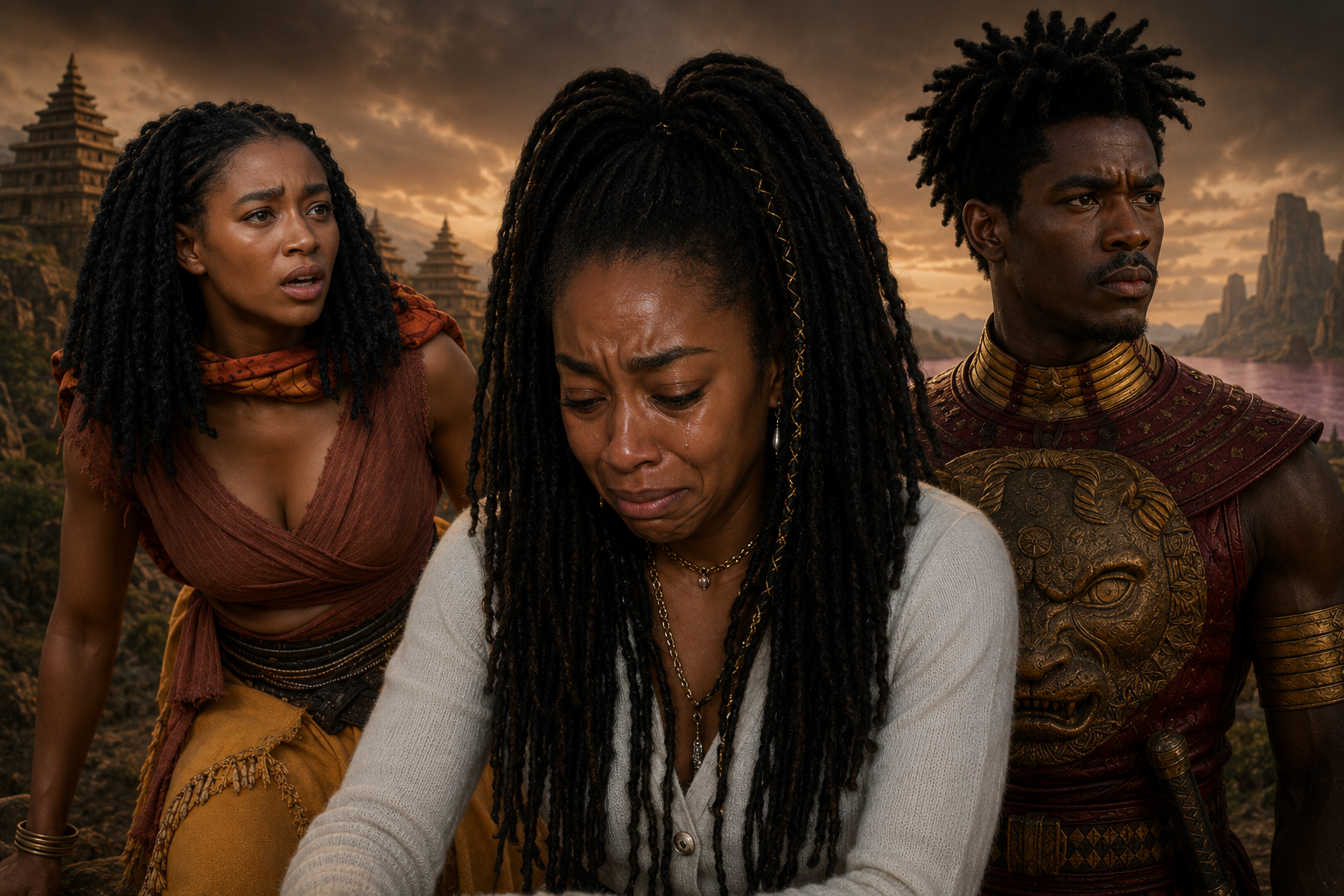
And there is already an underbelly of African AI creators emerging online. People are using these tools to imagine African fantasy worlds, futuristic cities, royal dramas, spiritual thrillers, ancient kingdoms, postcolonial power stories, Black sci-fi, African horror, and civilizational cinema that the traditional studio system would never have greenlit.
Some of it is rough. Some of it is early. But the imagination is there.
And that matters.
Because the bottleneck was never African imagination.
The bottleneck was capital, access, infrastructure, distribution, and gatekeepers.
AI may begin as proof of concept, but it does not have to end there. Yes, it can help African creators attract funding. It can help sell the vision to investors, producers, collaborators, and audiences. It can help a filmmaker walk into a room and say, “This is the world I am building.”
But as AI advances, it may also become the final vehicle itself.
Not just a pitch tool, a visual deck or a trailer before “real” production begins.
AI could become the production system through which African creators make full films, animated worlds, historical epics, spiritual thrillers, sci-fi universes, children’s stories, educational cinema, and civilizational archives outside the traditional studio model.
That changes everything.
Because if African storytellers can create, produce, and distribute their own cinematic worlds without waiting for Western financing, then the old gatekeeping structure loses one of its greatest weapons: permission.
AI does not solve every problem. It will not automatically create taste, discipline, cultural depth, strong writing, or artistic judgment. A lot of AI storytelling will be lazy, soulless, derivative, and visually impressive without emotional weight.
But the tool is not the point.
The sovereignty is the point.
For the first time, African storytellers may be able to render African imagination at scale without first begging Western institutions to finance, approve, translate, dilute, or validate it.
That is the real rupture.
Not using AI to imitate Hollywood.
Not using AI to make cheaper versions of Western films.
Not using AI to create African stories that still beg for Western approval.
The opportunity is to use AI to build African worlds on African terms — with African mythology, African memory, African futures, African beauty, African conflict, African ambition, and African power at the center.
The world is tired of being force-fed the same story.
The West may not know it yet, but its imagination has become repetitive. Its cultural authority is no longer automatic. Its stories are no longer universally exciting simply because they are Western.
The next great storytelling frontier is not another white billionaire family, it is civilizational storytelling, and Africa has civilizations the world has barely begun to see.


Leave a Reply