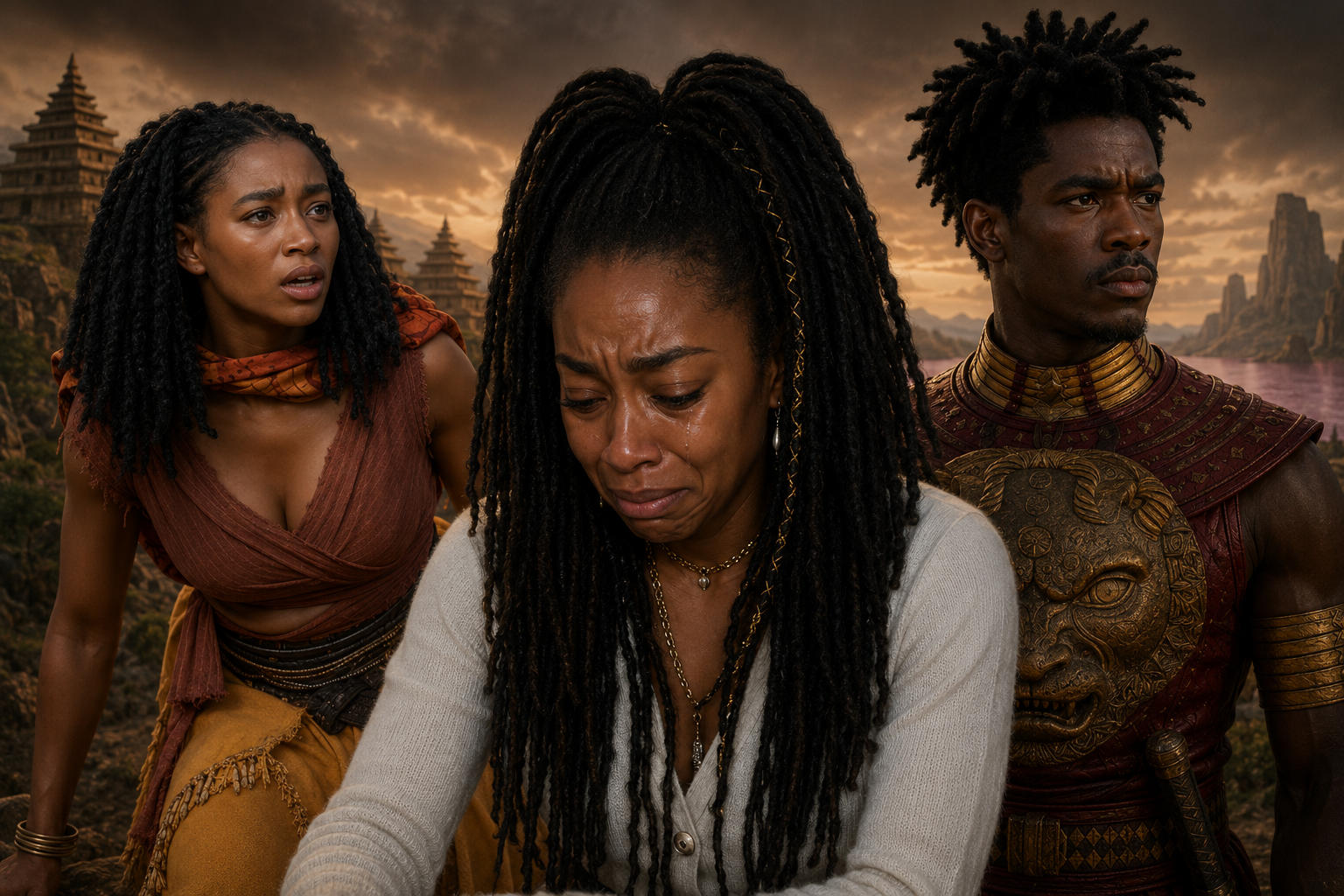

When Personal Catharsis Demarkets a Collective Breakthrough
As someone who has worked in Hollywood, worked with creatives, graduated art school, and business school, I understand both ends of this equation. I understand the emotional possessiveness of the artist: the years spent constructing a world, the intimacy of creating characters, and the pain of watching other people reinterpret what began inside your own imagination.
But I also understand business.
And film—especially a major studio film—is not simply personal expression. It is business, infrastructure, capital, coordination, compromise and collective labor. A novelist can sit alone and produce a book. A blockbuster film cannot be created alone. It requires financiers, studio executives, producers, screenwriters, directors, actors, costume departments, set designers, choreographers, distributors, marketers and hundreds, sometimes thousands, of workers whose livelihoods and reputations become attached to the project.
That is why I believe Tomi Adeyemi’s public repudiation of the film adaptation of Children of Blood and Bone is not merely an individual emotional response. It is a profoundly irresponsible business decision that threatens to do more harm to Black storytelling than good.
Adeyemi has publicly said that she will not watch or promote the adaptation, has described the experience as the worst thing she has ever lived through, and said that she left the film set hyperventilating and sobbing. Yet she has provided few concrete details explaining what happened behind the scenes.
The result is not accountability. It is demarketing.
She has demarketed the movie.
She has demarketed an adaptation of her own book before audiences have even had the opportunity to see it. She has introduced an atmosphere of negativity and suspicion around the film without giving the public enough information to evaluate the underlying dispute. Most people will never investigate the particulars. They will not carefully distinguish between the book, the author, the studio, the director and whatever may have happened on set. They will simply associate Children of Blood and Bone with conflict, trauma and something vaguely contaminated.
That damages the film. It damages the commercial prospects of the book and its sequels. It damages the possibility of a continuing franchise. And, because Hollywood so often treats one Black production as evidence for or against the viability of an entire category, it may damage the prospects of the Black epic that comes next.
Individual Trauma Is Not the Same as Collective Strategy
This is not an argument that Tomi Adeyemi did not experience something painful. She may very well have. Hollywood can be brutal. Its abuses, exclusions, humiliations and power imbalances are real.
But anybody who has reached a meaningful level of success—or even spent enough time hustling inside corporate and creative environments—has experienced some form of mistreatment. Black actors have been abused. Black directors have been marginalized. Black producers have had their authority undermined. Black writers have had their ideas appropriated. Black executives have spent entire careers fighting to remain in rooms that never wanted them there.
The collective has been traumatized.
That is precisely why no one individual’s trauma automatically becomes more important than the collective consequences of how that trauma is expressed.
Tomi is not speaking from complete powerlessness. She became a bestselling author, secured a major publishing career and saw her creation transformed into a large-scale studio production with an extraordinary ensemble of Black talent. The film is directed by Gina Prince-Bythewood and features performers including Thuso Mbedu, Amandla Stenberg, Damson Idris, Chiwetel Ejiofor, Cynthia Erivo, Idris Elba, Lashana Lynch, Viola Davis and Regina King. It is scheduled for an IMAX theatrical release in January 2027.
That is an almost unimaginable level of access for most writers of any race.
There are dark-skinned actresses who have waited their entire careers for productions of this scale. There are African writers whose manuscripts have sat unread for years. There are Black directors who cannot secure financing. There are producers who have endured executives telling them that Black films do not travel, African stories do not sell and international audiences will not pay to see Black people at the center of spectacle.
I have sat in versions of those rooms.
I know what it sounds like when executives explain why Black stories supposedly cannot work.
So when people finally overcome those objections, assemble the money, secure the studio support, bring together an exceptional cast and build a production of this scale, publicly demarketing that effort cannot be treated as an act affecting only the author.
It is kicking away the ladder.
Tomi climbed through one of the narrowest openings available to a Black female fantasy writer. Having reached the other side, she is now behaving as though the only story at stake is her own experience. But the ladder she is shaking is the same ladder that thousands of other Black creatives are still trying to climb.
The Recurring Collision Between Creativity and Business Acumen
There is a recurring problem among creatives: many understand expression but do not understand strategy.
They understand what they feel. They understand the truth they want to articulate. They understand the emotional urgency of being heard. But they may not understand capital, risk, leverage, timing, coalition-building, reputation, institutional incentives or the long-term consequences of public behavior.
The very emotional sensitivity that can produce extraordinary art can become a liability when it is not accompanied by business acumen.
The creative asks:
How do I express exactly what I am feeling right now?
The business strategist asks:
What outcome do I want five years from now, and what action today makes that outcome more likely?
Those are not always the same question.
The internet is not where executives solve problems. The internet is where audiences consume drama.
Posting online may produce attention. It may produce sympathy. It may create a temporary sense of emotional release. But attention is not infrastructure. Awareness is not change. Catharsis is not strategy.
I say this as someone who once believed more strongly in the power of vocalizing problems online. Speaking can raise awareness, and awareness has value. But awareness and change are not the same thing. Change requires ownership, financing, institutions, distribution, contracts, operational discipline and people willing to do the unglamorous work of building.
Coming online to announce that you will not watch your own film does none of that.
It does not correct the adaptation. It does not restore creative control. It does not create a new financing model for African cinema. It does not build a Black-owned studio. It does not protect the next author. It does not transfer ownership of our stories back into African hands.
It simply demarkets the existing product.
Not Every Feeling Belongs on the Internet
There is a place for emotional processing. It is called therapy.
There are family members, friends, mentors, lawyers, agents and experienced authors who understand the loss of control that often accompanies adaptation. There are other writers whose books have become films and who could have helped Tomi understand the realities of entering a medium in which authors are rarely sovereign.
Authors being unhappy with adaptations is not new. Stephen King famously objected to Stanley Kubrick’s interpretation of The Shining. P.L. Travers disliked Disney’s Mary Poppins. Ursula K. Le Guin condemned changes made to Earthsea. Alan Moore has repeatedly separated himself from adaptations of his work.
The fact that an author dislikes an adaptation is therefore not, by itself, a scandal. The strategic question is what the author does with that dissatisfaction.
Tomi is a storyteller. Had she wanted to examine the experience meaningfully, she could have transformed it into another book. She could have written a novel about the collision between a Black female artist and the machinery of Hollywood. She could eventually write a memoir about ownership, power, race, exploitation and adaptation.
That would be the artistically interesting response.
It would also be the business-savvy response.
Take the pain and create another asset. Turn the indignity into intellectual property. Build an audience around the deeper structural question. Use the visibility generated by the film to obtain the capital and leverage needed to control the next production.
That is how you win.
Instead of using the film’s platform to build the infrastructure she says is missing, she has used her platform to place a cloud over the film itself.
Amanda Seales, Cecile Emeke and the Burden of Holding the Wheel
We have seen versions of this dynamic within Issa Rae’s ecosystem.
Cecile Emeke, the British-Jamaican filmmaker behind the web series Ackee & Saltfish, directed the second episode of Insecure. The relationship later became publicly fractured amid allegations and accusations surrounding her experience with the production ecosystem. The complete circumstances remain disputed and poorly documented in reliable public reporting, so it would be irresponsible to pronounce definitively on who was right. But the public breakdown became another example of conflict overwhelming what should have represented an important creative bridge: a Black British woman who built independently on YouTube being invited to direct one of the most consequential Black television shows of its generation.
Amanda Seales represents a somewhat different case. Seales has publicly discussed her strained relationship with Issa Rae and people within Rae’s professional circle. She described feeling unprotected and unwanted within that environment, while also acknowledging that she initially avoided discussing the dispute because she understood the importance of Rae’s position in Hollywood.
Whatever one thinks of Seales, her later career has become increasingly consistent with activism, commentary and independent public advocacy. If someone determines that Hollywood is not the career environment they want, and chooses activism instead, that is a coherent decision. The person is accepting that public confrontation may close certain institutional doors while opening others.
But that is different from wanting studios to continue investing enormous sums into your creative work while simultaneously behaving as though the basic rules of collaboration, discretion and commercial stewardship should not apply to you.
I commend Issa Rae for something that is rarely acknowledged: she has had to keep her hand on the wheel.
She opened doors. She gave platforms to Black women and other Black creatives. She helped move people from the internet into mainstream television. And while building that ecosystem, she also had to manage the very human conflicts, disappointments, personalities and eruptions that can threaten the vessel from within.
Unfortunately, when Black businesspeople attempt to build collective infrastructure, it is sometimes our own people who poke holes in the boat.
That does not mean every criticism is sabotage. It does not mean Black creatives must be silent or grateful for mistreatment. But it does mean leadership requires distinguishing between criticism that repairs the vessel and behavior that sinks it.
You cannot build enduring Black institutions if every personal grievance becomes a public spectacle capable of destabilizing the entire enterprise.
The person steering the boat must sometimes continue steering despite the people aboard who are actively poking holes in it.
This Feels Like a Psyop
After everything it took to bring a major African-inspired fantasy to this scale—the years of convincing executives, the extraordinary cast, the vast capital committed, and the blood, sweat, tears and careers invested—it is almost impossible to watch this unfold without thinking:
This feels like a psyop.
It feels like a CIA plot.
I am not saying it is one.
I am saying that it is so perfectly calibrated to undermine collective progress that, if somebody wrote it into a screenplay, audiences might complain that it was too obvious.
A Black author receives an almost unprecedented opportunity. Her African-inspired fantasy becomes a major studio production. The production gathers some of the most prominent Black actors in the world. A Black female director is placed at its helm. Then, before the movie reaches theaters, the author publicly declares that the experience traumatized her, says she will not watch it, refuses to promote it and supplies almost none of the information the public would need to understand what actually happened.
What is the practical consequence?
The film is demarketed.
The book is placed under a cloud.
The audience is instructed to associate the production with harm.
The studio is handed another reason to view ambitious Black-led productions as unusually volatile.
The next African-inspired epic becomes harder to finance.
How could anyone deliberately designing an outcome hostile to collective progress improve upon that sequence?
Again, I am not alleging an actual conspiracy. I am describing how absurdly self-defeating this appears. It feels like a psyop because the outcome aligns so neatly with the interests of every executive who has ever argued that large Black films are too risky, too complicated or too difficult to finance.
Her Outburst Has Distracted From the Real Problems
The great frustration is that there are legitimate, urgent criticisms to make about Children of Blood and Bone and the wider Hollywood treatment of African stories.
Tomi’s outburst has distracted from them.
The first is the persistent whitewashing and cultural bastardization of African storytelling. Hollywood repeatedly recycles generic, inauthentic “African” accents that belong nowhere in particular. It collapses thousands of languages, ethnic groups and political histories into a vague continental aesthetic. It mixes names, garments, architecture, beliefs and vocal patterns as though Africa were a single interchangeable village.
Fantasy gives Hollywood even more permission to do this.
The response becomes: It is not meant to be accurate; it is fantasy.
But that excuse does not erase the political consequences of representation.
Fantasy permits studios to commodify African aesthetics without accepting the discipline of African history. It allows them to borrow the visual language, spiritual motifs, landscapes, names and cultural textures of the continent while escaping responsibility for accuracy. The result is often an Africa flattened into a marketable collage.
That is why I have always had complicated feelings about Children of Blood and Bone becoming such an important breakthrough.
Its success mattered. In 2016 and the years immediately following, the idea of a major African-inspired fantasy created by a young Black woman represented real progress. But there is something deeply troubling about the fact that Hollywood so readily amplifies imagined African kingdoms while Africa’s actual empires, civilizations, political movements, military histories and intellectual traditions remain largely absent from the screen.
Where are the major global films about the Sokoto Caliphate, the Ashanti Empire, the Kingdom of Kongo, the Oyo Empire, the Mali Empire beyond superficial references, the Haitian Revolution’s African dimensions, the women of Abeokuta, precolonial diplomacy, anticolonial resistance, the scramble for Africa from African perspectives, or the modern political architecture of independence?
The fantasy is marketable.
The historical truth is suppressed.
Fantasy becomes a containment mechanism: Africa can be powerful so long as that power is imaginary.
Wakanda and the Containment of African Power
Black Panther was culturally significant. It positioned Africa as technologically sophisticated, wealthy, beautiful and powerful. It gave Black audiences an image that had long been denied to us.
But Wakanda’s power also existed inside an American corporate and geopolitical frame.
Africa was permitted to become the most technologically advanced civilization on earth only within fantasy, under the ownership and narrative infrastructure of an American entertainment conglomerate. Its political meaning remained mediated through American racial discourse, American audience expectations and American corporate power.
That does not make Black Panther worthless. It makes it complicated.
The pattern is important: Africa can be great, but within containment. It can be powerful as long as the power is fictional. It can be sovereign on screen as long as the story itself remains owned, financed and distributed elsewhere.
That is not genuine African narrative sovereignty.
It is representational permission granted by an external power.
Hollywood Will Never Be Neutral About Africa
We must stop pretending that Hollywood is simply a creative ecosystem waiting to be persuaded into telling African stories correctly.
Hollywood is an instrument of American capital, American ideology and American soft power.
Paramount is now controlled through Paramount Skydance by David Ellison and the Ellison family—not Donald Trump personally. But the Ellisons are powerful technocrats operating at the intersection of media, technology, billionaire capital and American political influence. The Paramount-Skydance transaction was also surrounded by questions about Trump’s relationship with the company, CBS and the Ellisons.
This matters because ownership matters.
People who control studios have interests. They have political relationships. They have ideological assumptions. They have governments, shareholders, advertisers, distribution markets and reputational considerations to satisfy.
Their agenda will not automatically align with Africa’s agenda.
Even when Hollywood sincerely attempts to celebrate Africa, the result will still pass through institutions governed by people who are not accountable to African societies. We cannot repeatedly hand outsiders control of our image and then act shocked when the result feels inauthentic.
I had similar concerns even while appreciating The Woman King. Gina Prince-Bythewood made a compelling and important film. But admiration does not eliminate the structural question: who is authorizing the interpretation? Who controls the capital? Who selects which histories become global stories? Who decides what must be simplified for Western viewers? Who owns the intellectual property? Who earns the long-term financial return?
Representation inside somebody else’s institution is not the same as ownership.
The Real Answer Is African Capital
The deeper solution is not endlessly begging Hollywood to treat us better.
The solution is African capital.
Africa has millionaires and billionaires. It has banks, pension funds, family offices, sovereign wealth, telecommunications fortunes, development wealth, real-estate capital, technology founders and members of the diaspora with significant resources.
Yet much of that capital does not view storytelling as infrastructure.
That must change.
African investors may reasonably observe that historical films and prestige productions do not always offer the simplest or most immediately profitable business model. But storytelling produces returns beyond box-office receipts. It shapes tourism, trade, diplomacy, consumer perception, national confidence, cultural influence and global brand value.
A country that invests in its stories is investing in its international positioning.
Film is marketing infrastructure for civilizations.
African capital already funds office towers, luxury developments, political campaigns, private jets, sports teams and vanity projects. A fraction of that money, directed strategically into storytelling, could build film libraries, production studios, training academies, distribution systems, streaming platforms and intellectual-property portfolios owned by Africans.
The objective should not be charity.
The objective should be to crack the business model.
Bollywood did not wait for Hollywood to discover India. Indian filmmakers built an industrial ecosystem around Indian audiences, languages, stars, music, cultural expectations and distribution networks. Other countries have similarly treated cinema as both commerce and national projection.
Africa must do the same, although our model will need to account for multiple countries, currencies, languages, regulatory systems and fragmented distribution.
We should not merely demand that Africans appear in global films.
Africans must finance, own, direct, distribute and profit from African stories.
Millennials Must Build What the Previous Generation Did Not
I believe millennials and the generations behind us will have to solve this.
The older generation had opportunities to deploy capital toward cultural sovereignty, but too few understood film as both an industry and an instrument of power. Many did not understand the emerging economics of digital distribution, intellectual property, streaming, online audiences and global cultural commerce.
Our generation does.
We built the social-media age. We understand how stories travel without institutional permission. We understand direct-to-consumer audiences, digital communities, creator economics and the power of owning an audience rather than merely renting access to one.
As more African millennials accumulate wealth, we must decide what that wealth is for.
Will we reproduce the same consumption patterns as the generations before us? Or will we build institutions capable of shaping how Africa understands itself and how the world understands Africa?
This requires more than making films. It requires an integrated African storytelling economy: development funds, screenwriting institutions, historical research units, production facilities, completion financing, insurance, distribution, cinemas, streaming, merchandising, international sales and archival preservation.
The new African investor must understand that culture is not peripheral to development.
Culture is part of the operating system of power.
If You Want Control, Build the Infrastructure for Control
Authors have every right to want their adaptations handled faithfully. But the commercial reality is straightforward: unless you finance and control the film, you will not control every decision.
Selling adaptation rights means selling a degree of control.
A film is not a book with moving pictures. It is a different medium, involving different economics, time constraints, audience expectations and chains of authority. Once other people are assuming the financial risk, they will exercise power.
Creators who cannot accept that reality have another option: fund the production themselves.
Tyler Perry created control by building an operating model around ownership. Others have raised capital, assembled production companies, retained intellectual property and established distribution relationships. That road is more difficult than posting online, but it produces actual power.
Tomi could have used this film—whatever pain accompanied it—as leverage.
Let the movie amplify the book. Let the visibility expand the audience. Let the franchise establish her commercial bankability. Then use the money, recognition and relationships to create the production company capable of controlling her next world.
Get the business acumen.
Raise the capital.
Build the company.
Own the rights.
Hire the team.
Control the adaptation.
Get your revenge by winning.
That would address the structural problem. Publicly announcing that you refuse to watch the movie does not.
Black Creatives Cannot Afford to Be One-Dimensional
Black people, unfortunately, are rarely afforded the privilege of being only one thing.
A Black creative cannot merely be talented. To create lasting change, that person must also understand business, power, ownership, law, capital and institutional strategy.
This may not be fair. It is nevertheless true.
Artistic brilliance without commercial literacy can leave a creator celebrated but powerless. Activism without infrastructure can generate awareness without altering ownership. Visibility without leverage can make someone famous while the underlying institution remains unchanged.
Growth is a skill.
Business is a skill.
Restraint is a skill.
Strategic silence is a skill.
Knowing which forum serves which objective is a skill.
These are not betrayals of creativity. They are the tools required to protect creativity in a world governed by institutions and capital.
The ultimate lesson of this controversy should not be that Black artists must shut up and accept abuse. It should be that Black artists must become multidimensional enough to convert grievance into power.
Process the pain in the appropriate place.
Document wrongdoing when wrongdoing occurs.
Use legal and contractual channels where appropriate.
Turn the experience into art.
Then build the business model that makes it impossible for someone else to control your work again.
The Ladder Must Lead Somewhere
Tomi Adeyemi’s breakthrough was larger than Tomi Adeyemi.
It signaled that a young Nigerian-American woman could build a fantasy world rooted in African cultural imagination and command global attention. The adaptation, whatever its imperfections, represents years of labor by Black actors, filmmakers and workers who also understand what is at stake.
That does not mean Tomi owes Hollywood silence.
But she owes herself—and perhaps the ecosystem that helped make this moment possible—a strategy more sophisticated than public repudiation without explanation.
Her present approach does not expose the deeper structures governing African stories. It distracts from them.
It does not meaningfully challenge the inauthentic accents, the cultural flattening, the whitewashing or the substitution of fantasy for African history.
It does not build African ownership.
It does not transfer power.
It does not establish an alternative.
It demarkets the movie.
And when you are one of the few people who has managed to climb through the narrow opening Hollywood provides, you must understand that your conduct affects the people behind you.
The answer is not blind gratitude. The answer is not submission to abuse. The answer is strategic maturity.
Climb the ladder. Learn how the institution works. Accumulate leverage. Bring other people upward. Then use your capital and knowledge to build a structure we own.
Do not kick the ladder away while the rest of us are still climbing.
_________________________________________________
Here are more interesting takes on the conversation



Leave a Reply