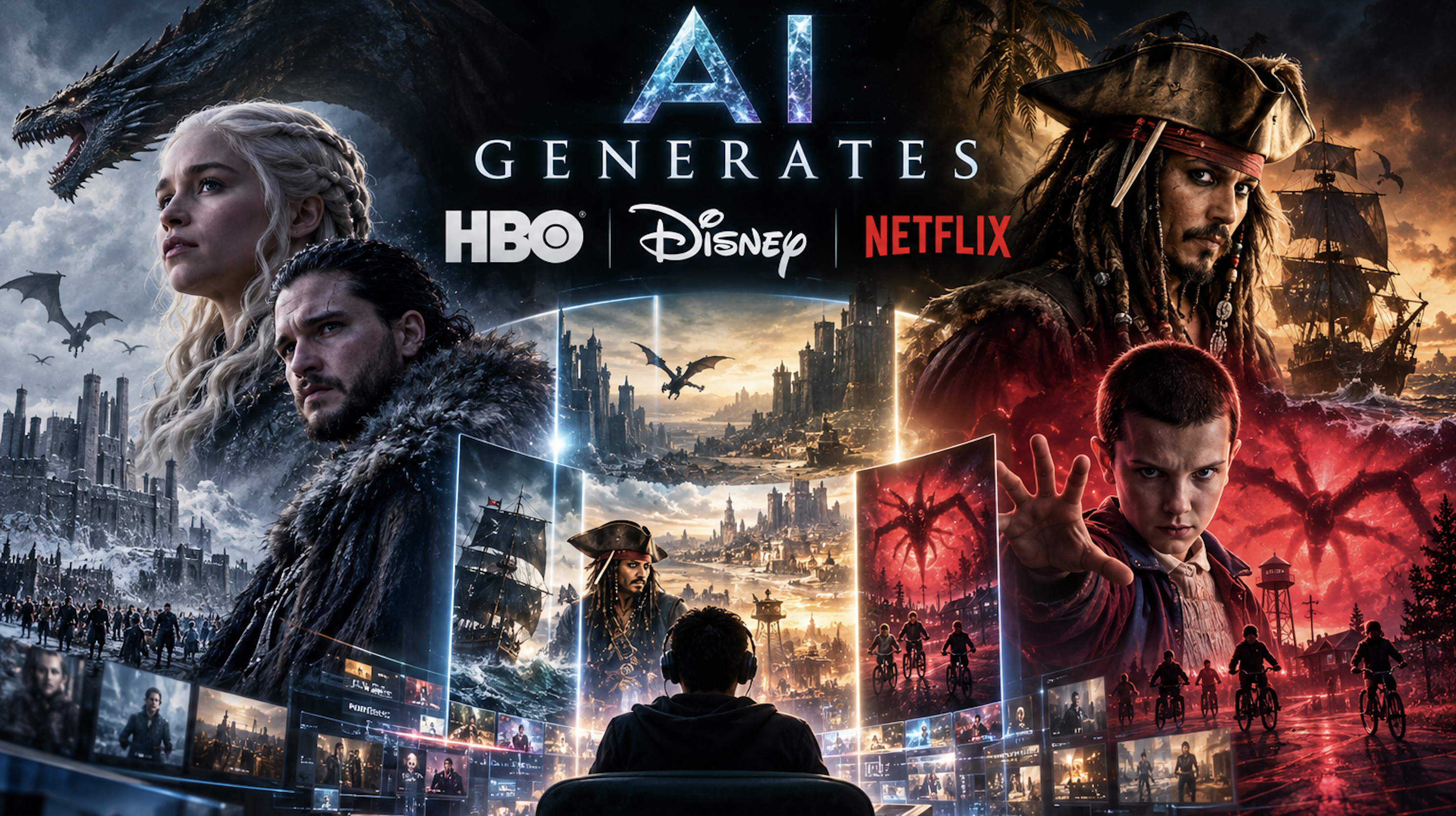
I can already go online and watch fans use generative AI to recreate Robert’s Rebellion, the war that precedes Game of Thrones and that fans have wanted to see on screen for years. Today, those videos are short, imperfect and inconsistent. But that is a technological limitation, not a permanent condition. In six months, a year or a few years, I may be able to watch a convincing feature-length version of Robert’s Rebellion without HBO ever making one.
Hollywood can look at this as an intellectual-property problem and spend the next decade trying to suppress it. Or it can recognize the much larger economic opportunity sitting in front of it: if audiences are going to generate, watch and share new stories from the worlds they love, why shouldn’t the rights holders build the ecosystems in which that activity happens?
Imagine opening a studio’s digital platform and initially encountering something that looks familiar: a personalized feed of videos, almost like YouTube. Some are official productions. Others are fan-generated films from across the studio’s intellectual property. The algorithm knows which worlds, characters and kinds of stories interest you and surfaces the most relevant and popular creations accordingly. You can simply watch, just as you would on any other entertainment platform.
But underneath that viewing experience, every piece of intellectual property has its own ecosystem. Enter one and you can watch what other fans have created, generate your own film or interpretation using the licensed world, publish it for others to experience, or create a personalized experience for yourself. The latter does not have to resemble traditional gaming. You do not necessarily need missions, points, controllers or objectives. You could enter a cinematic world and have AI generate an unfolding audiovisual experience around you while retaining the fundamental pleasure of film: story, character, surprise and immersion.
This would take an old internet behavior—fan fiction, fan forums and communities built around individual shows—and combine it with generative video, streaming and personalized entertainment. The old fan sites and message boards gave audiences somewhere to discuss and write themselves deeper into the worlds they loved. The next version could actually let them make and experience those worlds.

There is already an instructive model on the music side. HYBE’s Weverse brings different artist fandoms into one platform while giving each artist a distinct community containing media, fan activity, live content, memberships and other forms of engagement. HYBE describes Weverse as bringing community, content and commerce together, and the platform now allows fans not merely to consume artist content but to post, participate in listening parties and purchase digital memberships with additional benefits.
Film could take that architecture considerably further. Instead of an ecosystem organized around an artist, it could be organized around intellectual property. Instead of the fan merely posting about the world, the fan could generate inside it. And instead of a studio’s relationship with the consumer ending when the credits roll, the film could become the entrance into an ongoing economic ecosystem.
That may be one of the answers to the economic disruption generative AI is about to create for film.
Music Has Already Lived Through This Transition
The comparison with music is not that Napster and generative AI are technologically equivalent. It is that technological abundance repeatedly dilutes the economics built around scarcity.
Napster and LimeWire demonstrated what happened when recorded music could be digitally reproduced and distributed at almost no marginal cost. The recording industry’s existing economics were severely disrupted because the consumer no longer needed the physical object through which music had traditionally been monetized.
The eventual answer was not to recreate the CD economy. Streaming created a different one. Recorded music became extraordinarily abundant, while the broader business of music increasingly monetized the relationship surrounding the artist through concerts, merchandise, licensing, sponsorships, memberships and other forms of fandom.
There are plenty of legitimate debates about how those economics are distributed between artists, labels, publishers, promoters and platforms. But as an industry-level lesson, music adapted by finding ways to monetize beyond the individual recording.
In effect, the recording could become both product and marketing. It created the emotional relationship from which other economic activity could emerge.
Film needs to ask what happens if the movie begins performing a similar function.
Streaming Has Already Diluted Film Economics Once
Film is not beginning this transition from zero. Streaming has already changed the economics of the individual movie.
A theatrical ticket, DVD or rental once created a relatively direct economic relationship between a particular piece of entertainment and a particular transaction. Streaming bundled thousands of films and television shows into a monthly subscription. The consumer stopped assigning a separate price to every film and increasingly evaluated the value of the entire catalog.
At the same time, YouTube and the creator economy expanded the definition of entertainment itself. A studio production now competes for the same finite hours of human attention as podcasts, vlogs, livestreams, short-form video and creator programming. Traditional streamers consequently find themselves moving toward forms of content that historically belonged elsewhere, while YouTube increasingly competes for the television screen.
Generative AI pushes this economic dilution into a new frontier. Streaming made professionally produced entertainment abundant to consume. AI could make sophisticated entertainment abundant to produce.
That is a much larger disruption.
If a consumer can watch an entertaining fan-generated version of a story she has wanted for years, the official production no longer has an absolute monopoly over satisfying that desire. The substitute does not even have to be better. Economically, it only has to become good enough to take the viewer’s time.
The scarce resource then stops being content. It becomes attention.
The Studio Can Become the Platform for Its Own IP
The opportunity is not simply for studios to tolerate AI-generated versions of their intellectual property. It is to build the best place in which those versions can be created, watched and experienced.
Today, a fan who wants to create an AI-generated extension of a film or television series has to assemble the experience across multiple tools. They may generate characters in one place, video in another, voices somewhere else, edit the results themselves and eventually upload the finished product to a general video platform. The rights holder is largely absent from that process, despite owning the very thing that gives the creation its value: the world, characters and intellectual property the fan wants to experience.
A studio could collapse that entire process into its own platform. Each IP could have its own ecosystem containing the authorized assets and generation capabilities needed to create within that universe. Fans could arrive to watch the best creations from other users, generate their own versions, publish them for the community or create personalized cinematic experiences for themselves. At the platform level, all of those individual IP ecosystems would feed into a personalized stream of entertainment, allowing the strongest creations to travel across fandoms and giving the platform the network effects of creation, distribution and discovery.
This is where studios have an advantage that general-purpose platforms such as YouTube do not. YouTube can host an unlimited variety of video, but that breadth also creates extraordinary saturation. An official IP platform can offer depth instead: the easiest place to create within a particular universe, the highest-fidelity authorized tools and assets, the largest concentrated community of people who care about that universe, and potentially creations that cannot be watched anywhere else.
That could reverse the current relationship between the studio and platforms such as YouTube. Instead of YouTube being the destination where AI-generated extensions of Hollywood’s IP accumulate, it could become one of the places where those creations are discovered and marketed. A clip or trailer might circulate there, while the full experience, the best community creations and the tools required to make your own exist inside the rights holder’s ecosystem. Studios could also establish licensing terms governing which creations may be distributed externally and which remain exclusive to the platform.
The strategic response to AI therefore becomes much more ambitious than policing unauthorized generation. The rights holder can make the authorized environment so much easier, richer and more valuable that fans have a reason to create there in the first place. Rather than allowing the economic activity surrounding its worlds to disperse across AI tools and general video platforms, the studio brings generation, consumption, community and experience together around the IP it already owns.
In that model, YouTube does not disappear and AI generation is not suppressed. Their roles simply change. General platforms remain powerful channels for discovery, while the studio attempts to become the destination for the deepest experience of its own worlds.
That turns intellectual property from something a studio merely protects into something it can operate as a platform.
The Film Becomes the Beginning of the Transaction
The economic inversion is the most important part of this model.
Traditionally, a studio finances a story and the audience pays, directly or indirectly, to consume that story. The studio then finances another story to generate another cycle of consumption.
An AI-native IP ecosystem changes the equation. The studio creates the world, establishes its characters, mythology, aesthetic and canon, and then allows the audience to continue creating economic activity inside it.
A subscriber might primarily watch. Another might generate films. Another might create personalized experiences. Another might become a popular creator whose interpretations attract millions of views. A single membership could combine consumption and a certain level of generation, while heavier generation could be monetized separately because it carries real computing costs. The exact pricing model will evolve with the technology; the important change is what is being monetized.
The studio is no longer selling only the next film. It is monetizing continuing participation in the intellectual property.
This is where the economics begin to resemble what happened in music. If recorded music helped create demand for concerts and the broader artist ecosystem, perhaps film becomes the premium cultural product that creates demand for a much larger IP ecosystem.
The movie introduces the world and periodically advances its canon. The audience’s relationship with that world continues between releases.
What Is Film’s Equivalent of the Concert?
That is perhaps the central economic question.
Music discovered that something could become more valuable precisely because it could not be replicated like an MP3. A live performance is an event. It is finite, social and experiential.
Hollywood already understands this principle. Theme parks, studio tours, conventions and immersive experiences allow audiences to move from watching a fictional world to temporarily inhabiting it. The problem is scale. A physical experience requires a location, capacity, staffing and travel.
Generative entertainment potentially creates a scalable experiential layer.
A fan could enter the universe of a film from home and experience a story generated specifically for her. This does not have to become a conventional video game. The viewer may still want to be entertained rather than given tasks to complete. The experience could preserve cinematic storytelling while making the audience’s relationship to the world personal and dynamic.
Physical experiences would not disappear. Their scarcity could make them even more valuable. But they could sit at the top of a much larger ladder of engagement: canonical films, fan-generated films, personalized cinematic experiences, community, merchandise, live events and physical destinations, all monetizing the same underlying intellectual property in different ways.
In that model, the film industry’s answer to the concert may not be one thing. It may be the experience of belonging to the universe itself.
Fan Culture Has Been Telling Us This for Decades
None of the underlying consumer behavior is actually new.

Long before generative AI, audiences built fan-fiction communities, message boards and dedicated websites around the stories they loved. Sites such as B2Klovesyou.com belonged to an era when fandom created its own digital spaces around entertainment properties and performers. Fans did not simply want to receive the finished product; they wanted somewhere to discuss it, reinterpret it, write around it and interact with other people who cared about it.
HYBE’s Weverse is a more sophisticated contemporary expression of that same principle. Its artist communities combine official media with fan posts, live experiences and membership functions, while its broader platform aggregates many fandoms in one place.
Generative AI changes what that participation can produce.
Yesterday’s fan fiction was text. Tomorrow’s fan fiction can be cinema.
The opportunity is to design the platform for that transition rather than allow the entire economic activity to happen elsewhere.
Canon May Become More Valuable in a World of Infinite Versions
Allowing audiences to generate inside an IP does not necessarily mean surrendering canon.
In fact, the proliferation of alternative versions could make canon more important.
There may eventually be thousands of AI-generated interpretations of Robert’s Rebellion. But when the rights holder finally announces the canonical production, that work carries something none of the others can possess: narrative consequence within the official universe.
That creates a useful division of labor. Fans and AI can generate abundance, experimentation and continuous engagement. Studios can preserve scarcity around canon.
This could even relieve one of the economic pressures created by streaming. The streaming era has demanded an enormous pipeline of professionally produced content because platforms need something new to keep subscribers engaged. An AI-native ecosystem could allow the intellectual property to remain active between expensive canonical productions without requiring the studio to finance every hour of entertainment itself.
The audience supplies abundance. The studio supplies canon and monetizes everything.
That is a potentially much more powerful use of intellectual property than simply making more sequels.
Hollywood Needs to Design the Business Model Before AI Designs It for Them
Much of Hollywood’s AI debate has understandably focused on production: actors, writers, visual effects, jobs, likeness rights and whether AI can reduce the cost of filmmaking. Those questions matter enormously, but economically they address only how the existing product gets made.
The larger question is what the product becomes.
Music did not ultimately answer digital abundance by discovering how to manufacture CDs more cheaply. It developed new ways of distributing music and monetizing the relationship between artist and audience.
Film now needs the same level of business-model imagination.
Generative AI is likely to create more audiovisual entertainment than any studio could ever finance itself. Trying to suppress all of that activity may protect parts of the existing model, but it does not create the next one.
The opportunity is to consolidate the behavior audiences are already demonstrating. Give every IP its own generative ecosystem. Put those ecosystems together into a broader discovery platform. Let consumers watch the best creations, create their own, distribute them within licensed boundaries and move from watching a world to personally experiencing it. Build the subscriptions, generation economics, creator incentives, rights systems, commerce and physical experiences around that participation.
Then the studio is no longer trying to compete with infinite AI content by manufacturing infinite professional content.
It owns the world in which that content wants to exist.
That may ultimately be the economic frontier for film. The movie remains important, perhaps even more important, because it establishes the culture, canon and emotional attachment that make the ecosystem valuable in the first place. But the movie is no longer necessarily the end of the transaction.
It is the beginning of the relationship.
The defining question for the next generation of entertainment platforms may therefore no longer be simply, “What do you want to watch?” It may become something considerably more valuable: “Which world do you want to enter, and what do you want to create there?”

Leave a Reply