
Female authority, the fallacy of likability, and the difference between being good and being an effective leader.

Women are taught to make power palatable.
We celebrate women becoming leaders, but remain remarkably uncomfortable with what leadership actually requires once they arrive. A woman can be intelligent, collaborative, compassionate and ambitious, but the moment she begins enforcing hierarchy, overriding advice, punishing disloyalty or placing an objective above a relationship, the conversation shifts from her effectiveness to her character. Is she still a good person? Has power changed her? Has she become arrogant, cruel, difficult, authoritarian?
This is why Rhaenyra Targaryen has become such an interesting study of female leadership. Her evolution is increasingly being framed as a descent into darkness when much of what we are actually watching is a woman finally becoming comfortable with the authority she has always possessed.
Rhaenyra has made mistakes. She has been inexperienced, politically naïve and, at times, too concerned with proving that she is different from the people opposing her. But that is precisely what makes her evolution valuable. She has paid the school fees of leadership through betrayal, disobedience, political failure and the deaths of her children. The woman emerging from those experiences should not behave like the woman who entered them.
The lesson of Rhaenyra is not that women should become ruthless. It is that more women need to stop believing goodness requires powerlessness.

Cersei Was Allowed to Be Evil. Rhaenyra Is Required to Be Good.
There is a peculiar standard applied to female power: women are judged relationally where men are more often judged operationally. We want to know whether the woman is kind, whether people like her, whether she listens enough and whether she remains morally recognizable after acquiring power. Her relationships become evidence of her fitness to lead.
Men are routinely allowed to be terrible people without surrendering our fascination with their authority.
Aegon rapes Dyana. He frequents child fighting pits. Once given sovereign power, his impulses become political decisions. After his son’s murder, he cannot identify the guilty ratcatcher, so he hangs all of them. He later rides Sunfyre into battle from a mixture of frustration, wounded pride and the need to prove himself.
Yet give Aegon one triumphant return to King’s Landing and people cheer.
That is fascinating.
Aegon’s depravity does not prevent audiences from enjoying him. His failures make him complicated. His suffering humanizes him. His arrogance makes him entertaining. People are perfectly capable of separating the question Is Aegon a good person? from the question Is Aegon compelling when he exercises power?
Cersei Lannister reveals the same contradiction from the other direction.
Cersei was liberated by the fact that nobody expected goodness from her.
She could manipulate, threaten, torture, murder and eventually blow up the Great Sept of Baelor without violating some imagined contract requiring her to remain morally pure. Cersei was evil. We knew she was evil. She knew we knew she was evil.
And strangely, that freed her to become one of the most compelling women in Game of Thrones.
Cersei has an enormous fan base despite being the adversary because audiences could appreciate the sheer audacity with which she occupied power. She never apologized for wanting it. She never pretended hierarchy did not exist. She understood that information, fear, loyalty, family, sex and violence were all currencies inside the political system she inhabited.
Daenerys and Rhaenyra are given a much more dangerous burden.
They are introduced to us through goodness.
Now goodness becomes their cage.
Every escalation must be reconciled against the compassionate woman we met before. Every punishment becomes evidence of possible corruption. Every harder decision invites the question of whether she has “lost herself.”
This is where morality becomes a terrible substitute for ethics.
Westerosi morality condemns Rhaenyra’s sexual behavior while tolerating grotesque behavior from powerful men. It questions her sons while allowing kings to scatter bastards across the continent. It treats female inheritance as destabilizing while repeatedly handing kingdoms to incompetent men.
Why would we use that morality as an intelligent standard for leadership?
Ethics asks something more useful: whether power is being exercised legitimately, proportionately and in service of the responsibility attached to it.
And context matters enormously here because Westeros is not a democracy.
It is an autocracy.
The Iron Throne does not derive its authority from universal suffrage, polling numbers or approval ratings. Kingship itself is concentrated sovereign power. Yet audiences seem remarkably comfortable watching men inhabit that structure. Let a woman exercise the same sovereign authority without apologizing for it, and suddenly the language changes to tyranny.
People are more comfortable receiving autocracy from men than recognizing it in women.

Rhaenyra’s Greatest Weakness Was Trying Too Hard to Be Good
Rhaenyra’s great leadership problem was never that she lacked authority.
She lacked the experience to know when to stop negotiating it.
Watch early Rhaenyra at Dragonstone. Men interrupt her. Daemon acts independently. Her council pressures her toward war. People technically beneath her speak with the confidence of men who believe experience gives them partial ownership over the decision.
And Rhaenyra keeps explaining.
Some of that restraint is excellent leadership. She understands what almost nobody else in that room seems capable of comprehending: when dragons go to war, mistakes stop being reversible.
But there is a point at which restraint ceases to be strategy and becomes vulnerability.
Rhaenyra had already learned an earlier version of this lesson by leaving King’s Landing. She left because she wanted her sons away from the whispers surrounding their legitimacy. As a mother, she succeeded. She raised confident young men.
Politically, she created a catastrophe.
While Rhaenyra built psychological safety on Dragonstone, Alicent and Otto occupied the machinery of government beside a dying Viserys.
She possessed the succession.
They possessed the institution.
Then Viserys died, and Rhaenyra discovered the oldest rule of power: whatever you leave unattended eventually belongs, in practice, to the person who stayed.
Then the school fees became considerably more expensive.
Luke dies.
Daemon repeatedly acts according to his own judgment.
Councillors challenge her authority.
Jace dies.
People she trusts make decisions whose consequences she must absorb.
And slowly something changes.
Not her fundamental character.
Her pattern recognition.
This is what experience does to a leader. The first time someone circumvents your authority, you wonder whether there has been a misunderstanding. After the fifth time, you recognize the maneuver before it begins. The first time an older, more experienced person confidently contradicts you, you wonder what they know that you don’t. Eventually you discover how frequently confidence is simply ego wearing a suit.
Rhaenyra becomes harder because she now has data.
Hardening is not necessarily corruption.
Sometimes hardening is learning.
And this is where I think the writers need to be particularly careful. If Rhaenyra is genuinely going to become corrupted, then show us the corruption of her reasoning. Show ego replacing purpose. Show cruelty becoming pleasurable. Show her abandoning principles she previously understood because power itself has become the objective.
But simply showing a woman becoming more commanding after paying catastrophic prices for inexperience is not enough.
We have already watched this franchise struggle with that distinction through Daenerys Targaryen. Audiences spent years watching Daenerys wield extraordinary destructive power while attempting, however imperfectly, to discipline it around a larger purpose. When her final transformation arrived with insufficient psychological runway for many viewers, the result was not tragedy. It felt like narrative betrayal.
Repeating that structure with Rhaenyra would be even more frustrating because the more interesting story is already sitting in front of us.
It is the story of a woman learning how to rule.
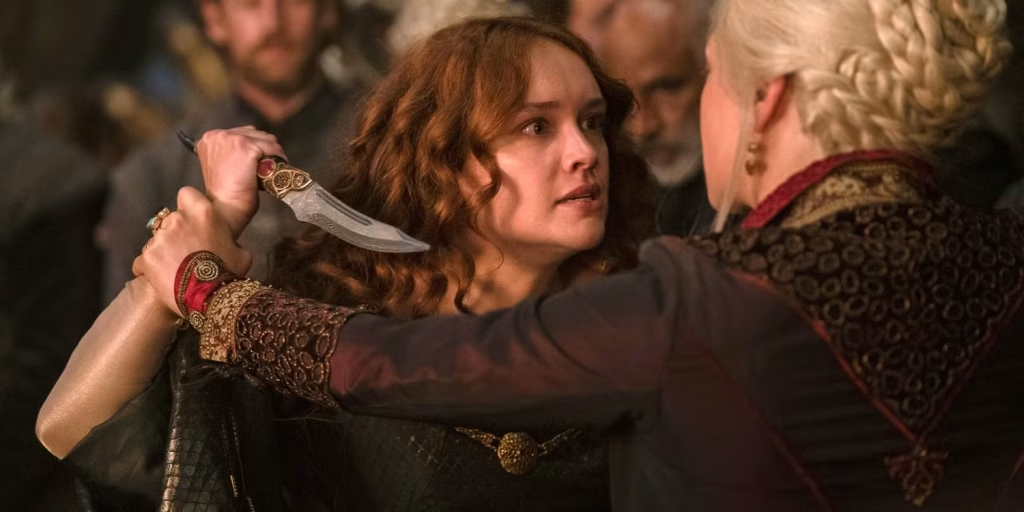
Alicent Is Alive Because Rhaenyra Has Restraint
Alicent may be the clearest evidence that Rhaenyra has not simply surrendered herself to tyranny.
If Rhaenyra were motivated principally by revenge, Alicent would be one of the easiest people in Westeros to justify destroying.
This is the woman whose political household helped place Aegon on Rhaenyra’s throne. She is inseparable from the machinery that produced the usurpation. She was once Rhaenyra’s closest childhood companion, making the betrayal intimate as well as political. Their history contains humiliation, resentment and eventually physical violence.
Rhaenyra has every emotional ingredient required for vengeance.
And yet when power reverses and Alicent becomes vulnerable to her, Rhaenyra does not simply unleash everything she is capable of doing.
She engages her.
She keeps her alive.
She feeds and houses those in her custody even while resources are constrained.
This is not weakness. It is controlled power.
And it exposes another problem in how audiences discuss female leadership. People ask why Rhaenyra gives Alicent attention while members of her own family are suffering, as though attention itself is evidence of emotional priority.
But a sovereign does not allocate attention according to affection.
She allocates attention according to usefulness.
Alicent is not merely Rhaenyra’s former best friend. She is a central political actor in the chain of events that placed Aegon on the throne. She knows the Greens. She knows their motivations, relationships and weaknesses. She is connected to the opposing dynasty by blood.
Of course Rhaenyra engages her.
The relationship is emotionally complicated because Rhaenyra is still human. Leadership does not require emotional amputation.
But the fact that a relationship contains emotion does not mean the relationship lacks strategic value.
This is exactly the relational fallacy through which women are so often judged. People see two women with an intimate history and immediately interpret their interactions through feelings. A leader sees intelligence, leverage, history and access.
Both can be true simultaneously.

Mysaria Reveals the Difference Between Love and Leadership
Mysaria provides the inverse example.
Here Rhaenyra has a relationship with someone who becomes personally important to her but increasingly incompatible with the kind of authority she needs to exercise.
That is one of the hardest leadership decisions because it does not involve an obvious enemy.
It involves someone you care about.
Mysaria has spent her life searching for safety. Rhaenyra understands this. And when their relationship ends, she does something revealing: she gives Mysaria the very thing she has always claimed to want.
Safety.
Money.
Freedom.
An escort to Pentos.
The ability to live independently with servants and without being trapped beneath someone else’s power.
That is not how a tyrant treats someone who has ceased being useful.
It is how a leader rewards service while still recognizing that the relationship itself can no longer continue.
And Mysaria refuses it.
Why?
Because by then safety is no longer enough.
She has tasted proximity to power.
That changes the meaning of her character completely.
The woman who once wanted freedom from powerful people now wants influence over power itself. Rhaenyra offers her an exit most people in Mysaria’s position could never dream of receiving, and she returns to the game.
Then she betrays the woman who elevated her.
There is an extraordinary leadership lesson inside that.
Sometimes people tell you they want security until they experience influence.
Sometimes the person you rescued from powerlessness becomes unwilling to surrender the power your rescue gave them.
And sometimes leadership means recognizing that loving or rewarding someone does not obligate you to continue giving them access.
Rhaenyra removing Mysaria from her immediate orbit is not evidence that she has stopped caring.
It is evidence that she has finally learned that relationships must serve the mission rather than govern it.

Then There Is Ulf
And nowhere is the mythology surrounding power exposed more beautifully than through Ulf.
People like the idea that ordinary people would exercise power more humanely because they know what powerlessness feels like.
Then give an ordinary man a dragon.
Suddenly Ulf, who has spent most of his life at the bottom of the social hierarchy, possesses one of the most destructive weapons in existence.
And he becomes intoxicated by it.
At Tumbleton, Rhaenyra is the person attempting to preserve innocent lives. She specifically pushes against indiscriminate destruction.
Yet the town burns anyway.
And the man responsible is not the increasingly “authoritarian” queen.
It is Ulf.
Even Daemon—hardly a moral innocent, a man who has killed and ordered killing and spent his life close to violence—can comprehend the horror of what is happening.
That contrast is extraordinary.
The queen understands restraint.
The prince with decades of proximity to power understands restraint.
The common man who has only recently acquired extraordinary power does not.
Power is not made ethical simply by giving it to someone who was previously powerless.
Sometimes deprivation produces empathy.
Sometimes it produces hunger.
And once that hunger is given a dragon, the consequences can be catastrophic.
That is why leadership requires discipline rather than simply virtue.
The question is not whether someone comes from the people, loves the people or claims to represent the people.
The question is what they do once they possess the ability to destroy them.
Rhaenyra’s problem for much of the story has actually been the opposite of Ulf’s.
He acquires power and immediately becomes intoxicated by it.
She possesses enormous power and spends too long afraid of what exercising it might make her.
Her leadership evolution is about finding the point between those extremes.

The Iron Throne Is Not the Purpose. The Line Is.
Leadership becomes meaningless without purpose because purpose is what separates authority from ego.
Rhaenyra’s purpose is larger than becoming queen.
Viserys chose her as his heir and entrusted her with something Aegon never received: Aegon the Conqueror’s prophecy. She understands that Targaryen succession carries an obligation beyond the person occupying the Iron Throne. A catastrophic threat will eventually come from the North, and the dynasty must survive so that the realm can be united against it.
Rhaenyra does not know the names Jon Snow and Daenerys Targaryen.
We do.
And that dramatic irony changes the meaning of her struggle.
She is fighting to preserve a succession whose ultimate purpose she understands but whose eventual beneficiaries she will never meet.
Aegon was not Viserys’s chosen successor. He was not entrusted with the prophecy.
Rhaenyra was.
And history gives the audience an advantage none of these characters possess: we know her line matters.
Rhaenyra herself does not survive the Dance, but Aegon III does. Her son becomes king. Her bloodline continues through the dynasty and ultimately reaches the generations that produce Daenerys and, through Rhaegar, Jon Snow, whose lives become central to the realm’s confrontation with the threat from the North.
That is stewardship.
A weak leader thinks about possessing power.
A serious leader understands what the power is for.
Once purpose is clear, everything else can finally be placed in hierarchy beneath it.
Popularity matters because legitimacy affects the mission. Relationships matter because alliances affect the mission. Compassion matters because gratuitous cruelty destabilizes the realm. Restraint matters because destroying the kingdom in order to inherit it would represent complete strategic failure.
But none of those variables can become substitutes for the objective itself.
This is what makes Alicent, Mysaria, Daemon and even Rhaenyra’s own children so useful to understanding her evolution. Each relationship presents the same test in a different form: can she separate what someone means to her personally from what the mission requires of her as sovereign?
Earlier Rhaenyra struggles with that distinction.
Later Rhaenyra increasingly understands it.
Alicent can be loved and still be politically useful.
Daemon can be her husband and still be subordinate.
Mysaria can be cared for and still lose access.
Her children can be cherished and still carry obligations as princes.
That is not emotional coldness.
That is hierarchy.
And hierarchy is one of the fundamental responsibilities of leadership.

Seize Your Power
Perhaps this is why Cersei, Daenerys and Rhaenyra provoke such different reactions despite all being extraordinarily powerful women.
Cersei escaped the goodness trap by never pretending to be good.
Daenerys became trapped inside it because audiences were taught to understand her power through liberation and compassion, making her final transformation feel like the destruction of the character they had spent years understanding.
Rhaenyra gives us the opportunity for something far more interesting.
A woman does not have to become Cersei in order to stop being accommodating.
She does not have to become evil before she can become authoritative.
And she does not have to abandon compassion in order to understand that compassion without boundaries can become vulnerability.
Look at what Rhaenyra actually does when relationships collide with power.
She does not slaughter Alicent despite having every emotional reason to hate her.
She does not punish Mysaria merely because their relationship has ended. She gives her money, protection and the possibility of the safe life Mysaria once claimed to want.
She attempts to protect the civilians of Tumbleton even while fighting a war for survival.
These are not the decisions of a woman intoxicated by absolute power.
They are the decisions of someone still attempting to discipline power around purpose.
And that distinction is everything.
Women have spent generations being taught how to soften themselves around authority. How to make the sentence nicer. How to preserve the relationship. How to ensure everyone feels heard. How to question themselves before questioning the person challenging them. How to make ambition appear accidental and power appear collaborative even when the final responsibility belongs entirely to them.
Women already know how to accommodate.
What many have not been taught is how to remain ethical while becoming unapologetically authoritative.
That requires knowing when listening has become permission-seeking. It requires accepting that somebody can dislike you without making you wrong, that somebody can love you and still undermine you, and that someone you once helped can become dangerous once proximity to your power changes what they want.
Most importantly, it requires knowing your purpose well enough that relationships cannot continually reorganize your priorities.
This is the real lesson of Rhaenyra Targaryen.
Not ruthlessness.
Not tyranny.
Not revenge.
The discipline to know what your power is for and the courage to use it accordingly.
Rhaenyra was always capable of commanding dragons. The much harder education was learning how to command people: advisers who believed they knew better, men who confused proximity with authority, friends whose histories complicated their usefulness, lovers whose access eventually became dangerous, and subjects whose approval could never be guaranteed.
She paid for that education with almost everything.
So if the woman emerging from it is harder, more certain and less interested in explaining herself, perhaps we should stop immediately asking what has gone wrong with her.
Perhaps we should ask what she has learned.
Because there is a profound difference between a woman becoming corrupted by power and a woman finally becoming comfortable with having it.
And more women need to learn the difference.



Leave a Reply